Most marketing spend used to be a bet. You’d buy a billboard or a TV spot, hope it worked, and wait months to find out. Performance marketing removes the guesswork: you pay for results you can measure, not for attention you can’t.
If you’re trying to decide whether to invest in it, hire an agency for it, or just understand what your marketing team keeps talking about, this guide breaks down exactly how performance marketing works, what it costs, and when it’s the right fit.
Quick Answer
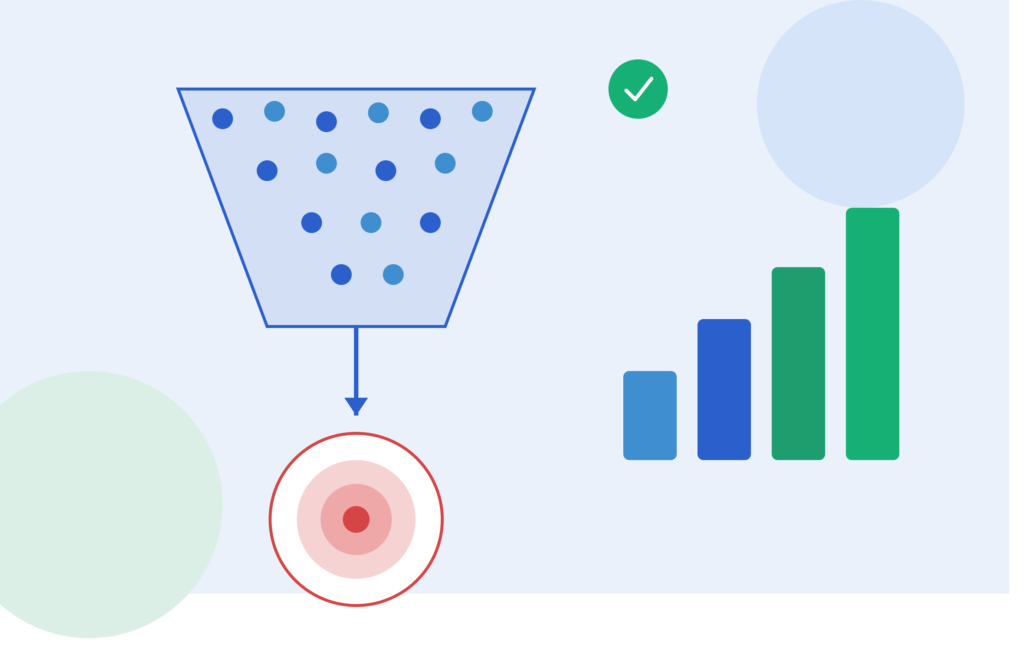
Performance marketing is a form of digital advertising where advertisers pay only when a specific, measurable action happens — a click, a lead, a sale, or an app install. Instead of paying for ad space or airtime upfront, you pay for outcomes, which makes it possible to track return on investment (ROI) down to the dollar.
Table of Contents
- How Performance Marketing Works
- Performance Marketing vs. Brand Marketing
- The Main Performance Marketing Channels
- Key Metrics and How to Calculate Them
- Real-World Examples
- Is Performance Marketing Right for Your Business?
- Common Mistakes to Avoid
- Getting Started: A Simple Roadmap
- FAQs
- Key Takeaways
How Performance Marketing Works
Performance marketing runs on a simple loop: an advertiser sets a goal, a platform or publisher shows ads to relevant people, and the advertiser pays only when someone completes the desired action.
That action — called a conversion — could be:
- Clicking a link
- Filling out a form
- Signing up for a trial
- Installing an app
- Completing a purchase
Here’s the mechanism in four steps:
- You define the action you’ll pay for (a sale, a lead, a click).
- You set a bid or budget for that action through a platform like Google Ads, Meta Ads, or an affiliate network.
- The platform serves your ad to people likely to convert, using audience targeting and machine learning.
- You’re charged only when the defined action happens — not for impressions that don’t convert (in most models).
This is different from traditional advertising, where you pay for placement regardless of outcome. A print ad costs the same whether it sells one product or zero.
Performance Marketing vs. Brand Marketing
These two approaches aren’t competitors — they solve different problems. Confusing them is one of the most common budgeting mistakes businesses make.
| Performance Marketing | Brand Marketing | |
|---|---|---|
| Goal | Drive a specific, measurable action | Build long-term recognition and trust |
| Payment model | Pay per result (CPA, CPC, CPL) | Pay for reach or airtime (CPM, flat fee) |
| Timeline | Short-term, fast feedback | Long-term, slow feedback |
| Measurability | Highly precise | Harder to attribute directly |
| Example | A Google Ads campaign selling running shoes | A Super Bowl ad for a shoe brand |
| Risk | Lower — you pay for outcomes | Higher — spend happens regardless of outcome |
Most mature companies run both. Brand marketing builds the audience that performance marketing later converts.
The Main Performance Marketing Channels
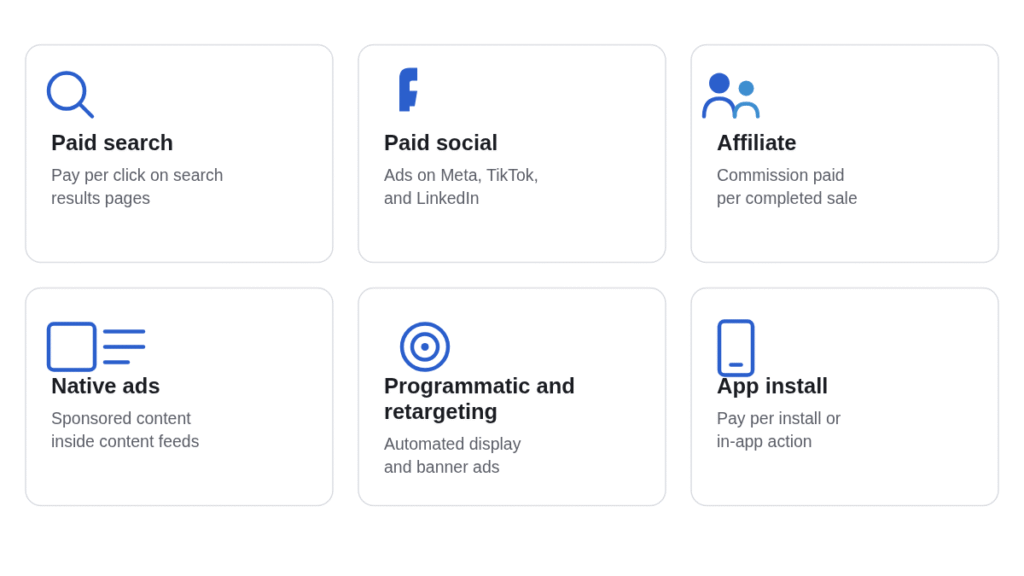
Paid Search (PPC)
Ads that appear in search engine results, typically paid per click. Google Ads and Microsoft Advertising are the dominant platforms. Best for capturing people already searching for a solution.
Paid Social
Ads on platforms like Meta (Facebook/Instagram), TikTok, LinkedIn, and Pinterest. These are usually cost-per-click or cost-per-thousand-impressions, but campaigns are optimized toward conversion events like purchases or sign-ups.
Affiliate Marketing
You pay third-party publishers or influencers a commission for every sale or lead they generate. Risk is minimal since you only pay after a sale closes.
Native Advertising
Sponsored content that matches the look and feel of the platform it’s on (think “recommended articles” widgets). Priced per click, optimized toward downstream conversions.
Programmatic Display and Retargeting
Automated ad buying that shows banner or video ads to specific audiences, often people who already visited your site. Priced per click or per thousand impressions, with performance tracked toward conversion.
App Install Campaigns
Ads that pay per install or per in-app action, common on platforms like Apple Search Ads, Google Ads (UAC), and Meta.
Email and SMS Marketing
Not always classified as “paid” performance marketing, but it’s measured the same way: cost per acquisition against revenue generated, especially when using paid list-growth tactics.
Key Metrics and How to Calculate Them
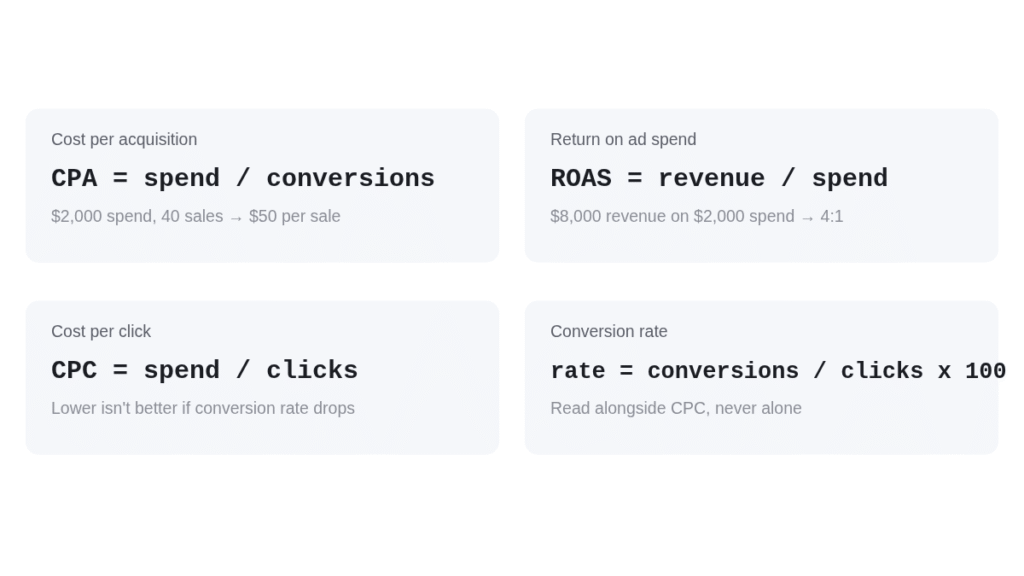
Understanding these formulas is the difference between running performance marketing and actually reading the results.
Cost Per Acquisition (CPA)
CPA = Total Ad Spend ÷ Number of ConversionsExample: $2,000 spent, 40 sales → CPA = $50 per sale.
Return on Ad Spend (ROAS)
ROAS = Revenue Generated ÷ Ad SpendExample: $2,000 spent generates $8,000 in revenue → ROAS = 4:1, or 400%.
Cost Per Click (CPC)
CPC = Total Ad Spend ÷ Total ClicksCost Per Lead (CPL)
CPL = Total Ad Spend ÷ Number of LeadsConversion Rate
Conversion Rate = (Conversions ÷ Total Clicks) × 100A campaign with a low CPC but a poor conversion rate can still lose money — always evaluate metrics together, not in isolation.
Real-World Examples
E-commerce: An online skincare brand runs Meta Ads targeting people who viewed a product but didn’t buy (retargeting). They pay per click, track ROAS in real time, and pause any ad set that drops below a 3:1 return.
SaaS: A project management tool runs Google Ads on the keyword “best project management software.” They pay per click, but track cost per trial signup and per paid conversion, since not every click becomes a paying customer.
Mobile app: A fitness app runs install campaigns across TikTok and Apple Search Ads, paying per install, then measures cost per install against average subscription revenue to judge profitability.
Affiliate: A mattress company partners with review sites, paying a commission only when a referred visitor completes a purchase — eliminating upfront risk entirely.
Is Performance Marketing Right for Your Business?
Performance marketing tends to work best when:
- You have a clear, trackable conversion event (a sale, a lead, a signup)
- Your product has a short-to-medium sales cycle
- You can tolerate iterative testing and short-term budget risk
- You want spend accountability tied directly to revenue
It’s a weaker fit when:
- Your goal is pure brand awareness with no direct action to measure
- Your sales cycle is very long and offline (e.g., enterprise deals closed over months of relationship-building)
- You have no landing page or conversion infrastructure to track results
Ready to Stop Guessing and Start Scaling?
Running performance marketing well means daily bid management, constant creative testing, and staying ahead of platform algorithm changes — a full-time job most in-house teams don’t have the bandwidth for. If reading this made you realize you’d rather have an expert handle it than learn it the hard way, that’s exactly what I do.
I manage performance marketing campaigns for growing businesses, with every dollar tracked against real ROAS, not vanity metrics.
[Book a free strategy call]) and get a no-obligation audit of what your ad spend could actually be doing for you.
Common Mistakes to Avoid
- Optimizing for clicks instead of conversions. Cheap clicks that don’t convert are wasted spend.
- Ignoring attribution windows. A sale credited to an ad clicked 30 days ago may overlap with other channels — align attribution settings with your actual sales cycle.
- Pausing campaigns too early. Most platforms need a “learning phase” (often 1–2 weeks) before performance stabilizes.
- Chasing vanity metrics. Impressions and reach don’t pay bills; conversions and ROAS do.
- No landing page optimization. Even a perfect ad fails if the page it sends people to is slow or unclear.
Getting Started: A Simple Roadmap
- Define one conversion event you’ll measure success against (e.g., a purchase).
- Install tracking (Google Analytics 4, Meta Pixel, or your platform’s conversion tracking) before spending a dollar.
- Start with one channel where your audience already spends time — usually paid search or paid social.
- Set a test budget you’re comfortable losing while you learn what works.
- Review CPA and ROAS weekly, not daily — most channels need time to optimize.
- Scale what works, cut what doesn’t, and reinvest saved budget into top performers.
FAQs
Is performance marketing only for e-commerce? No. It applies to any business with a measurable conversion event, including SaaS, lead generation, mobile apps, and services.
How much should I budget to start? There’s no universal number — it depends on your average order value and industry CPC. A common approach is starting with enough budget to generate at least 20–30 conversions, so you have enough data to judge performance reliably.
What’s the difference between performance marketing and digital marketing? Digital marketing is the umbrella term for all online marketing, including SEO, content, and email. Performance marketing is a subset focused specifically on paid, measurable, results-based campaigns.
Can performance marketing work alongside SEO? Yes, and it often should. SEO builds long-term organic traffic while performance marketing delivers faster, more controllable results — they complement each other well.
Do I need an agency, or can I run it myself? Small budgets and simple funnels can often be managed in-house using platform tools. Larger or multi-channel campaigns usually benefit from specialist expertise to avoid wasted spend during the learning phase.
Key Takeaways
Start small, track everything before spending, and scale only what’s proven to work.dPress. This is your first post. Edit or delete it, then start writing!
Performance marketing means paying for measurable results, not ad space.
Main channels include paid search, paid social, affiliate, native, programmatic, and app install campaigns.
CPA and ROAS are the two metrics that matter most for judging success.
It works best with a clear conversion event and a short-to-medium sales cycle.
[Talk to a performance marketing expert] and find out what’s possible for your budget.